
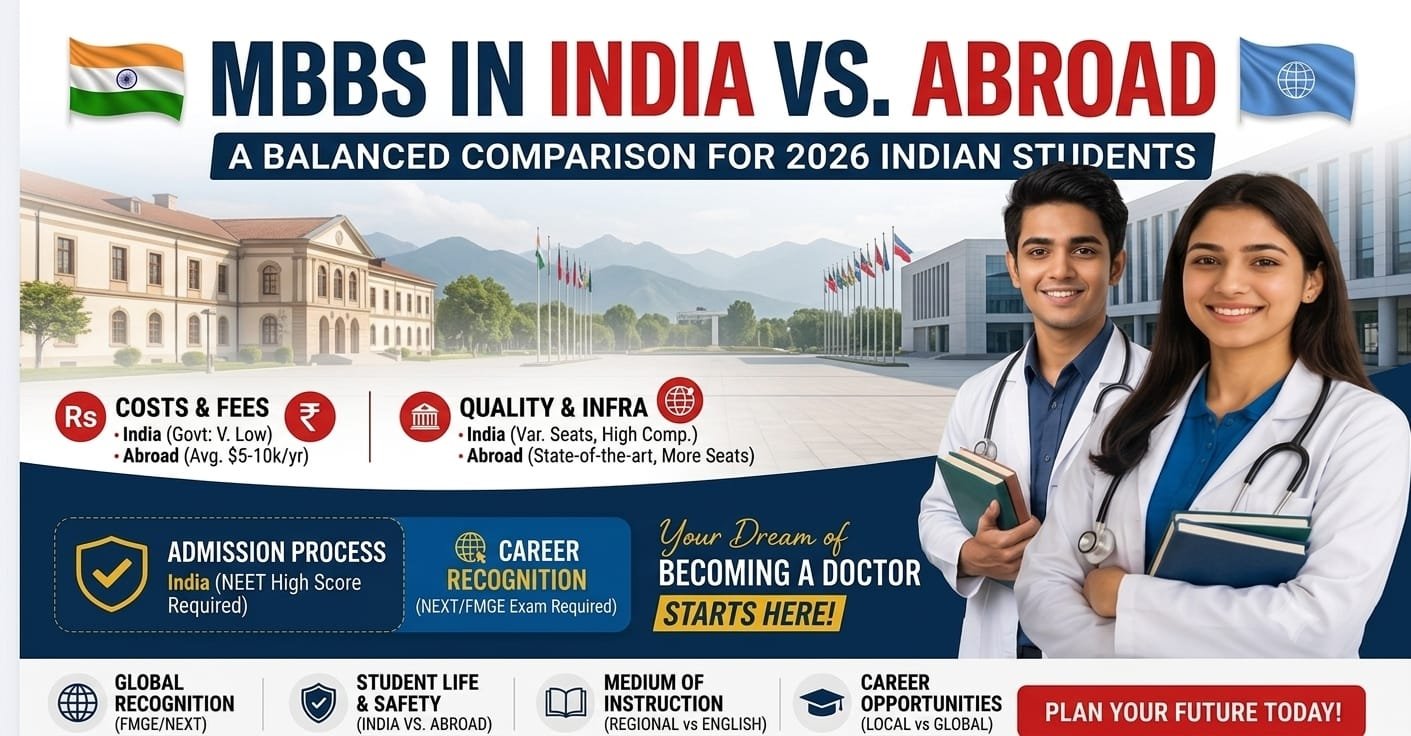
MBBS in India vs Abroad 2026: Which Is Better for Indian Students?
Choosing between MBBS in India and MBBS abroad is one of the biggest decisions for a medical student and their family. Both options can lead to a medical career, but the admission process, fees, competition, living environment and requirements after graduation can be different.For Indian students, the decision should not be based only on the course fee. Students should also consider their NEET score, budget, university, clinical training, eligibility requirements and their long-term plan to practise medicine in India.In this guide, we will compare MBBS in India vs Abroad in terms of admission, fees, course duration, education, clinical exposure, licensing requirements and career opportunities.
MBBS in India vs Abroad 2026: Which Is Better for Indian Students?
| Factor | MBBS in India | MBBS Abroad |
|---|---|---|
| Entrance Exam | NEET-UG | NEET-UG qualification is required for Indian students |
| Competition | Very high, especially for government seats | Varies by country and university |
| Government College | Highly competitive | Not applicable |
| Private College | Available, but fees can be high | Many foreign universities have comparatively lower costs than Indian private options |
| Course Duration | Generally 5.5 years including internship | Usually 5–6 years depending on country/university |
| Medium of Instruction | Mainly English | Depends on university; verify before admission |
| Clinical Training | In India | Depends on university and programme |
| Practice in India | Indian graduates follow Indian registration requirements | Foreign graduates must meet India’s applicable licensing requirements |
| International Exposure | Limited compared with studying abroad | Opportunity for international exposure |
| Visa/Travel | Not required | Required |
| Living Abroad | Not applicable | Students need to adapt to a new country and culture |
Note: Course duration, fees, internship structure and licensing requirements can vary. Students should verify the current rules and university-specific details before admission.
1.Why Are Students Considering MBBS Abroad?
Every year, a large number of students compete for medical seats in India. This makes the admission process highly competitive, particularly for government medical colleges.
For students who do not secure their preferred medical seat in India, studying medicine abroad can be another option.
Countries such as Georgia, Kyrgyzstan, Russia, Kazakhstan and Uzbekistan are considered by Indian medical aspirants, but the right university should be selected carefully rather than choosing a country only because of low fees.
Students interested in specific destinations can also explore our detailed guides on MBBS in Georgia and MBBS in Kyrgyzstan to understand the available options, admission process and important considerations before applying.
2. MBBS Fees: India vs Abroad
This is one of the biggest reasons families compare both options.
In India, the total cost can be very different depending on whether the student gets a government seat, private seat, deemed university seat or another category.
For MBBS abroad, the total cost depends on the country, university, tuition fee, hostel, food, insurance, visa, flights and personal expenses.
Therefore, there is no single “MBBS abroad fee.”
A student should always calculate the complete cost of education, rather than looking only at tuition fees.
What should you include in the total cost?
- Tuition fee
- Hostel
- Food
- Medical insurance
- Visa expenses
- Flight tickets
- Books and study material
- Local transportation
- Personal expenses
- Currency exchange costs
Important: Government MBBS in India can still be substantially cheaper than studying abroad. The comparison becomes particularly relevant when students are comparing private medical education in India with foreign medical universities. Current 2026 comparison sources show a wide range in both Indian private and overseas costs, so exact figures should be checked university by university.
3. NEET Requirement for MBBS in India vs Abroad
For Indian students, NEET-UG is an important requirement for pursuing MBBS, including when applying for medical education abroad, subject to the applicable rules.
However, the meaning of a qualifying NEET score and the actual admission process should not be confused with getting a medical seat in India.
In India, your NEET rank/score plays a major role in counselling and seat allocation.
For MBBS abroad, the university’s admission requirements, country-specific rules and applicable Indian regulations must also be checked.
4. MBBS Admission Process: India vs Abroad
The admission process for MBBS in India and abroad differs in several ways. Students should understand the eligibility criteria, entrance examination requirements and admission procedures before choosing their preferred option.
MBBS Admission Process in India
To pursue MBBS in India, students generally need to:
-
Complete Class 12 with Physics, Chemistry, Biology/Biotechnology and English as required under the applicable eligibility rules.
-
Qualify for the NEET-UG examination.
-
Participate in the relevant counselling process conducted by the authorised counselling authorities.
-
Meet the required NEET merit, eligibility and document verification criteria.
-
Complete the admission formalities and pay the prescribed fees after seat allotment.
Admission to government and private medical colleges depends on factors such as NEET rank, category, seat availability, eligibility and the applicable counselling rules.
MBBS Admission Process Abroad
Indian students planning to study MBBS abroad should carefully check the following steps:
-
Qualify NEET-UG as required under the applicable Indian regulations.
-
Verify that the foreign medical programme meets the requirements applicable to Indian students who intend to practise medicine in India after graduation.
-
Check the university’s eligibility criteria, course duration, medium of instruction and clinical training arrangements.
-
Review the complete fee structure, including tuition, accommodation, food, insurance, visa and other expenses.
-
Submit the application and required academic documents to the university.
-
Complete the admission, visa and travel formalities before joining the programme.
Which Admission Process Is Better?
MBBS admission in India can be highly competitive, particularly for government medical seats. Studying abroad may provide another option for eligible students, but admission should never be based only on an offer letter or low tuition fees.
Students and parents should independently verify the university, programme structure, clinical training and applicable licensing requirements before paying any admission fee.
5. MBBS Course Duration: India vs Abroad
Course duration is another important factor when comparing MBBS in India and MBBS abroad. Students should understand not only the number of study years but also the internship and clinical training requirements.
MBBS Duration in India
In India, the MBBS programme generally takes 5.5 years, including 4.5 years of academic study and one year of compulsory rotating medical internship, subject to applicable regulations.
During this period, students study subjects such as Anatomy, Physiology, Biochemistry, Pathology, Pharmacology, Medicine, Surgery, Paediatrics and other clinical disciplines.
The programme combines classroom learning, practical sessions and clinical training to prepare students for medical practice.
MBBS Duration Abroad
The duration of medical programmes abroad varies by country and university. Many programmes take approximately 5 to 6 years, but students must verify the exact structure before admission.
The total duration may depend on:
-
Academic study requirements
-
Clinical rotations and practical training
-
Internship arrangements
-
Language requirements
-
The university’s curriculum and applicable regulations
Indian students planning to practise medicine in India after graduating abroad should check whether the programme meets the applicable NMC requirements, including the prescribed course duration, internship and other eligibility conditions.
Does a Shorter Course Mean a Better Option?
Not necessarily. Students should not choose a medical university simply because it advertises a shorter course duration.
The quality of clinical exposure, curriculum, internship arrangements, eligibility for registration and recognition under the applicable rules are more important than the number of years alone.
Before taking admission, students and parents should obtain written confirmation of the programme duration and training structure directly from the university.
6. Quality of Education and Clinical Exposure: India vs Abroad
The quality of medical education is an important factor when choosing between MBBS in India and MBBS abroad. Students should look beyond the country name and evaluate the curriculum, teaching methods, hospital facilities and practical training offered by the specific medical college or university.
Medical Education in India
Medical colleges in India follow the applicable national medical education framework. Students learn through classroom teaching, laboratory practicals, clinical postings and supervised patient care.
The advantages may include:
-
Studying in a familiar language and cultural environment.
-
Exposure to Indian patients, diseases and healthcare settings.
-
Clinical training within the Indian healthcare system.
-
Greater familiarity with local medical practice and patient communication.
However, the quality of facilities, teaching and clinical exposure can vary between institutions. Students should evaluate individual colleges rather than assuming that every college offers the same experience.
Medical Education Abroad
Foreign medical universities may offer different teaching methods, campus facilities and international learning environments. The actual experience depends on the university, its affiliated hospitals and the programme structure.
Before applying, students should check:
-
The curriculum and teaching language.
-
Availability of practical classes and clinical rotations.
-
Access to teaching hospitals and patient exposure.
-
Opportunities for supervised hands-on clinical training.
-
Language support for communicating with local patients.
-
The university’s compliance with applicable requirements for students intending to practise in India.
Studying abroad can provide valuable international exposure, but the quality of training should be verified independently.
Why Is Clinical Exposure Important?
Clinical exposure helps medical students connect theoretical knowledge with real patient care. Through supervised hospital training, students learn to take patient histories, conduct examinations, understand diagnoses and observe treatment procedures.
The amount and quality of clinical exposure depend on factors such as hospital patient load, clinical rotation schedules, supervision and opportunities to interact with patients.
For students planning to return to India, it is particularly important to understand the clinical training and internship requirements that apply to foreign medical graduates.
How Should Students Compare Medical Colleges?
Students and parents should compare individual institutions using reliable information rather than relying only on advertisements or promotional claims.
Request details about the curriculum, teaching hospitals, clinical rotations, faculty, total course duration and internship arrangements. Verify the information through official university documents and the applicable regulatory authorities.
Remember: A medical degree is a long-term investment in your career. Choose a college based on the quality of education, practical training and eligibility for your intended career path—not just the country or advertised fees.
If you are planning to study MBBS abroad and want to practise medicine in India after graduation, understanding the National Medical Commission (NMC) rules is very important.
The NMC regulates the requirements that foreign medical graduates must meet to become eligible for medical registration in India. Students should check these requirements before choosing a foreign medical university.
What Is NMC?
The National Medical Commission (NMC) is India’s medical regulatory body. It sets standards for medical education and regulates the requirements for practising medicine in India.
Indian students planning to study medicine abroad should understand the applicable NMC regulations before taking admission.
Important NMC Requirements for MBBS Abroad
Under the Foreign Medical Graduate Licentiate (FMGL) Regulations, 2021, students covered by these regulations must meet the applicable requirements, which include:
-
Course duration: The medical course must meet the prescribed minimum duration requirements.
-
Medium of instruction: The course must be taught in English.
-
Medical subjects: Students must study the required subjects and complete the prescribed theoretical, practical and clinical training.
-
Internship: The course and internship must meet the applicable NMC requirements.
-
Registration eligibility: Students must satisfy the relevant requirements for medical registration in India after graduation.
The detailed conditions are important, so students should read the official regulations rather than relying only on information provided by an agent or university.
Does NMC Approve Every Foreign Medical University?
No. The NMC does not endorse a general list of foreign medical universities for Indian students.
Students should not assume that a university is suitable for practising medicine in India simply because it offers an MBBS-equivalent degree or advertises admission to Indian students.
Before applying, verify the university, the complete course structure, clinical training, internship arrangements and applicable registration requirements.
Why Should Students Check NMC Rules Before Admission?
Choosing a medical university without checking the applicable requirements can create serious problems after graduation.
A student may complete the degree abroad but still face difficulties obtaining medical registration in India if the course does not meet the required conditions.
Therefore, students and parents should verify all important details before paying admission fees.
How Can You Verify the Requirements?
Follow these steps before making a decision:
-
Read the applicable regulations and advisories published on the official NMC website.
-
Obtain the complete course structure and internship details directly from the university.
-
Confirm the medium of instruction and clinical training arrangements.
-
Check the medical registration requirements in the country where the university is located.
-
Keep written records of the university’s responses and official documents.
Important: Admission to a foreign medical university does not automatically guarantee eligibility to practise medicine in India. Students must fulfil the applicable regulatory and licensing requirements.
Many Indian students who study MBBS abroad plan to return to India and work as doctors. Before choosing a foreign medical university, students should understand the examination and registration requirements that apply after graduation.
What Is FMGE?
FMGE stands for Foreign Medical Graduate Examination. It is a screening examination for eligible Indian citizens and other candidates covered by the applicable rules who have obtained their primary medical qualification abroad and want to practise medicine in India.
Eligible candidates must meet the examination requirements and pass the screening test, where applicable, before proceeding with the required medical registration process.
What Is NExT?
NExT stands for National Exit Test. It is an examination framework introduced under India’s medical education legislation.
NExT is intended to serve important purposes related to medical licensing and postgraduate medical admissions. However, its implementation and examination schedule depend on official decisions and notifications.
Students should check the latest announcements from the National Medical Commission (NMC) and the National Board of Examinations in Medical Sciences (NBEMS) instead of assuming that NExT has already replaced every existing examination requirement.
Do MBBS Abroad Graduates Need to Pass FMGE?
Eligible foreign medical graduates are generally required to pass FMGE under the currently applicable screening-test framework, unless a specific exemption or different applicable rule applies.
The exact requirements depend on the candidate’s eligibility, admission date, medical qualification and the regulations applicable to their case.
Students should verify the latest official examination notification before planning their return to India.
What Happens After Passing FMGE?
Passing FMGE does not automatically mean that a graduate can immediately start practising medicine.
Depending on the applicable rules and the candidate’s circumstances, the graduate may need to:
-
Complete any required internship or clinical training.
-
Fulfil the applicable medical registration requirements.
-
Submit the necessary documents to the relevant State Medical Council or other authorised registration body.
-
Obtain the required registration before practising medicine in India.
The applicable rules should be checked carefully because eligibility and registration procedures can vary according to the candidate’s circumstances.
How Can Students Prepare for Their Future Medical Career?
Students planning to study MBBS abroad should think about their long-term career before selecting a university.
They should understand the licensing examination requirements, choose a university that meets the applicable regulations, maintain their academic records and ensure that they receive the required clinical training.
Important: No university or consultancy can guarantee that a student will pass a licensing examination or automatically become eligible to practise medicine in India. Students should make admission decisions based on verified information and official requirements.